
Beam hardening correction for industrial CT
Beam hardening makes the center of a part look less dense than its edges and draws dark streaks between dense structures. Voxray QRT models the X-ray spectrum during reconstruction, so gray values stay consistent across the part from a single scan.
What is beam hardening?
An X-ray tube emits a spectrum of energies, not a single one. Material absorbs low-energy photons more easily than high-energy ones, so a beam that has passed through a thick or dense region contains mostly high-energy photons: it has become harder. A harder beam loses less intensity per millimeter of material.
Filtered backprojection (FDK), the reconstruction most CT scanners ship with, assumes a single X-ray energy. It reads the weaker attenuation along long paths as lower density. The thicker and denser the material along a ray, the larger the error.
How to recognize it
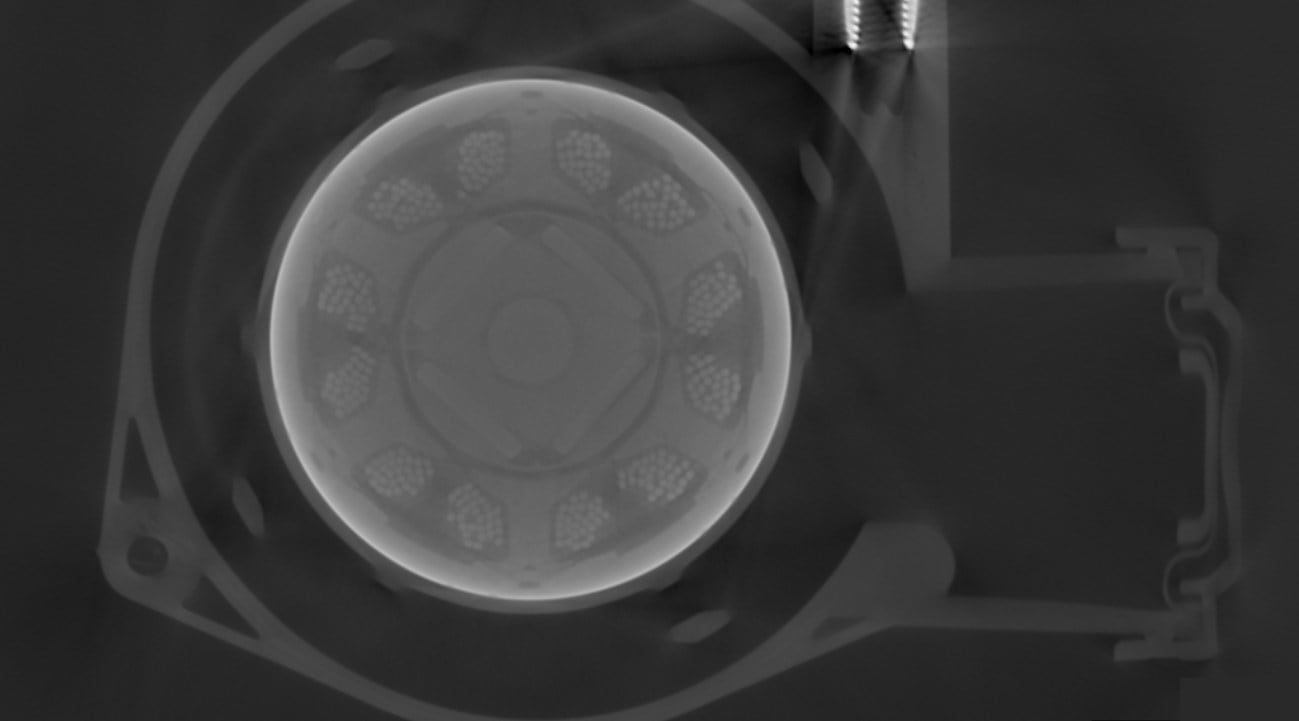
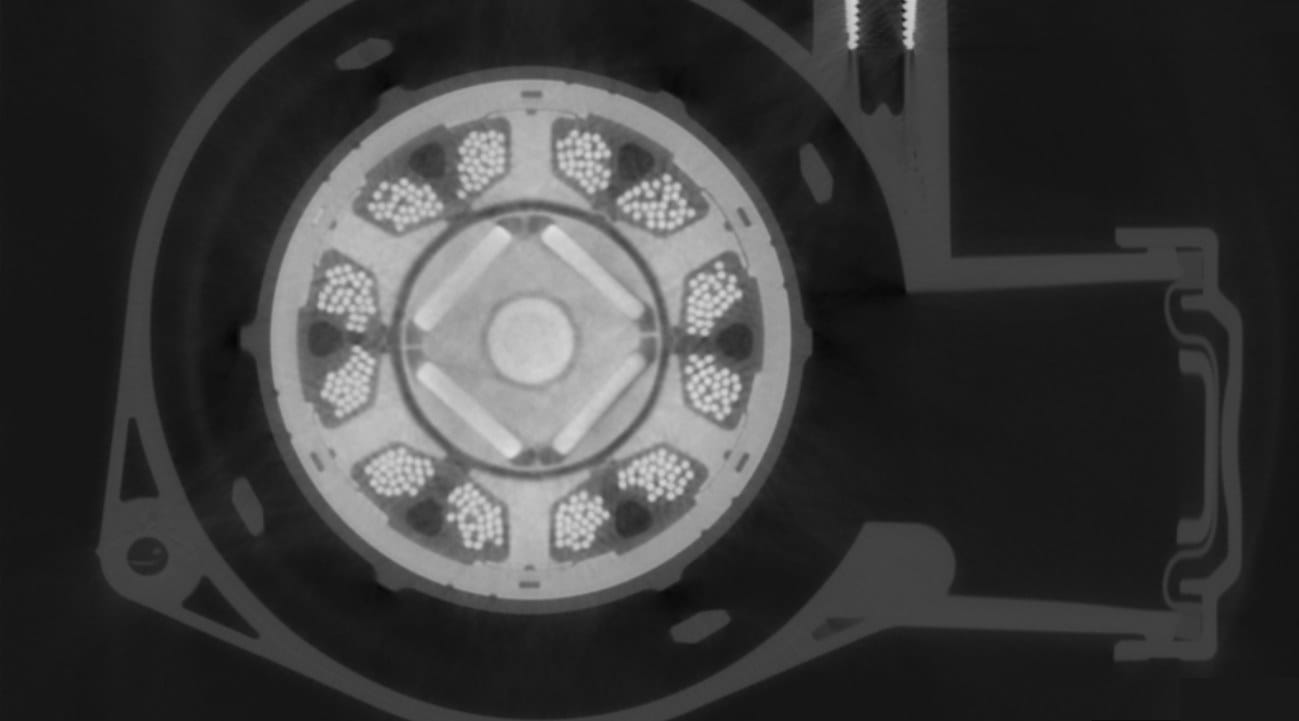
Cupping: a homogeneous part looks darker in the center than at the edges.
Dark streaks or bands between dense structures such as pins, battery cells or screws.
The same material gets different gray values depending on wall thickness and position, which breaks global thresholds and surface determination.
Low-density materials next to dense ones lose contrast, so voids, cracks and inclusions there disappear.
Before and after
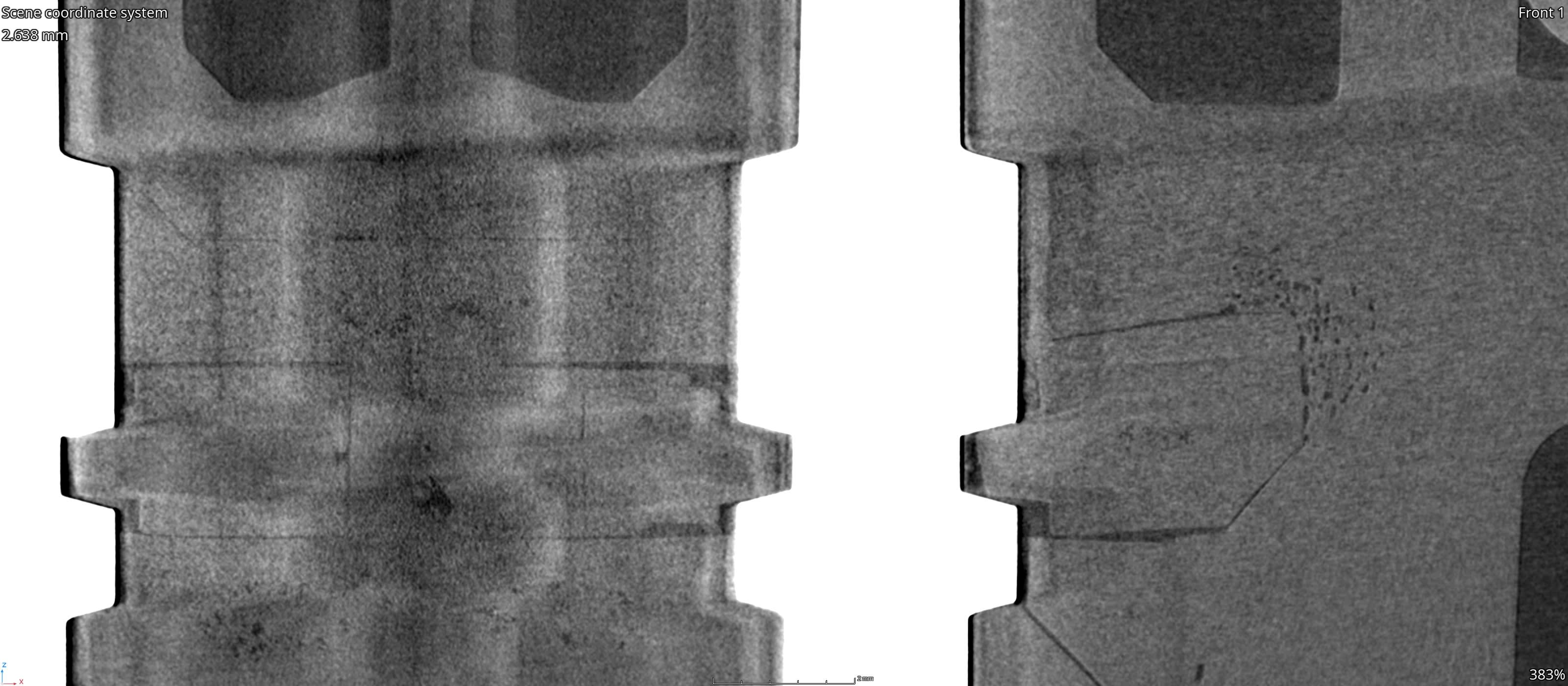
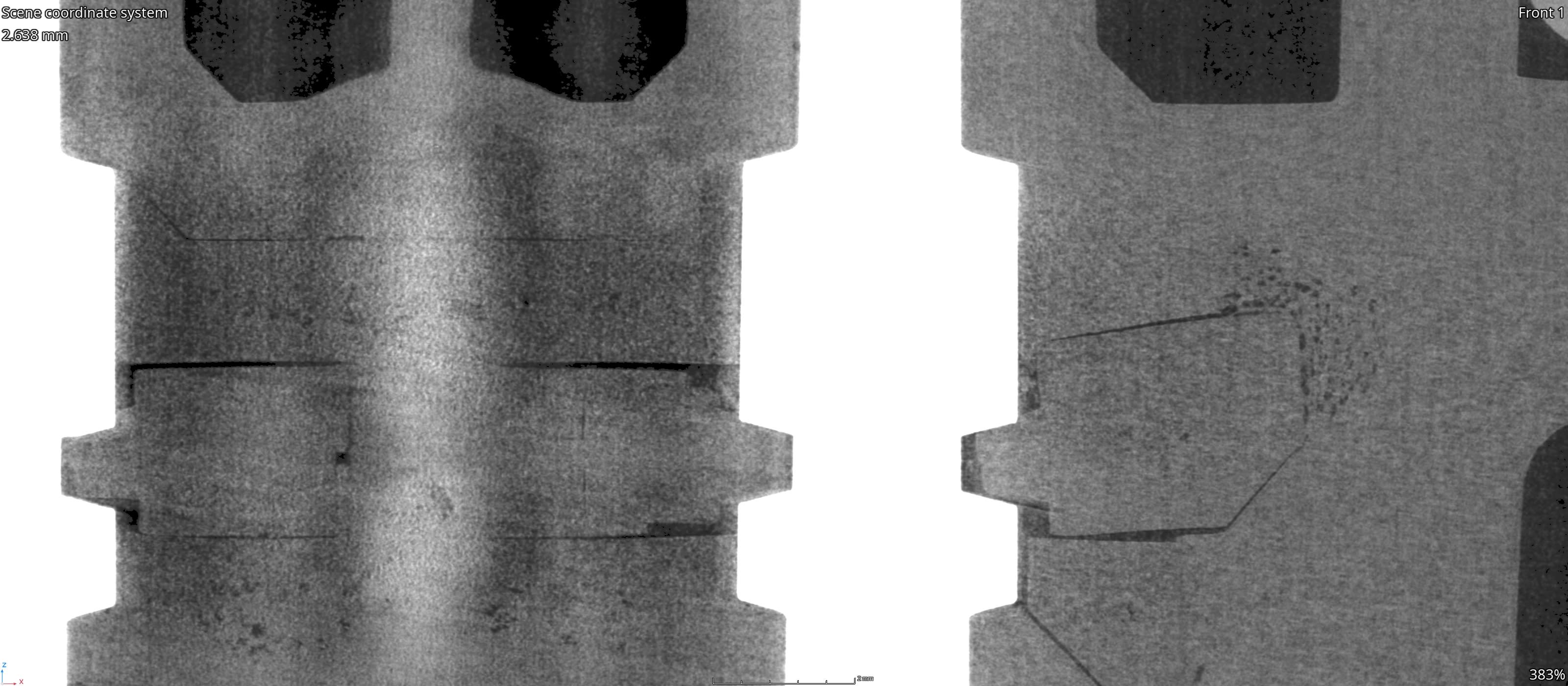
Conventional reconstruction compared with Voxray QRT on real scans. Drag the slider to compare.
Common ways to correct beam hardening
Each conventional method fixes part of the problem and adds a cost elsewhere.
Physical prefilter
How it works: A copper or tin filter in front of the tube removes low energies before they reach the part.
Limits: Reduces cupping but does not remove it, and costs signal, so scans get noisier or longer.
Higher tube voltage
How it works: Raises the share of high-energy photons in the spectrum.
Limits: Lowers the contrast between materials of similar density.
Linearization (software correction)
How it works: Maps the measured attenuation to a straight line, using a calibration on a reference part or a hand-tuned polynomial.
Limits: Assumes a single material. In multi-material parts it corrects one material and distorts the others.
Dual-energy CT
How it works: Scans the part twice at two tube voltages and fuses the two volumes.
Limits: Doubles the measurement time, and registering the two volumes can add alignment artifacts.
How Voxray QRT handles beam hardening
QRT does not straighten the projections before reconstruction. It models the polychromatic X-ray spectrum and the physics of the measurement, and computes the volume that best explains the recorded projections. Beam hardening is part of that model, so it does not turn into cupping or streaks.
Multi-material parts
Metal, plastic and composite in the same part, where single-material linearization fails.
One scan
No second scan at another tube voltage and no registration of two volumes.
Automatic correction
The correction runs during the reconstruction, and the default settings give good results for nearly all datasets.
Your scanner, your software
QRT reads the raw projections of your existing scanner and writes VGI or DICOM for your analysis software.
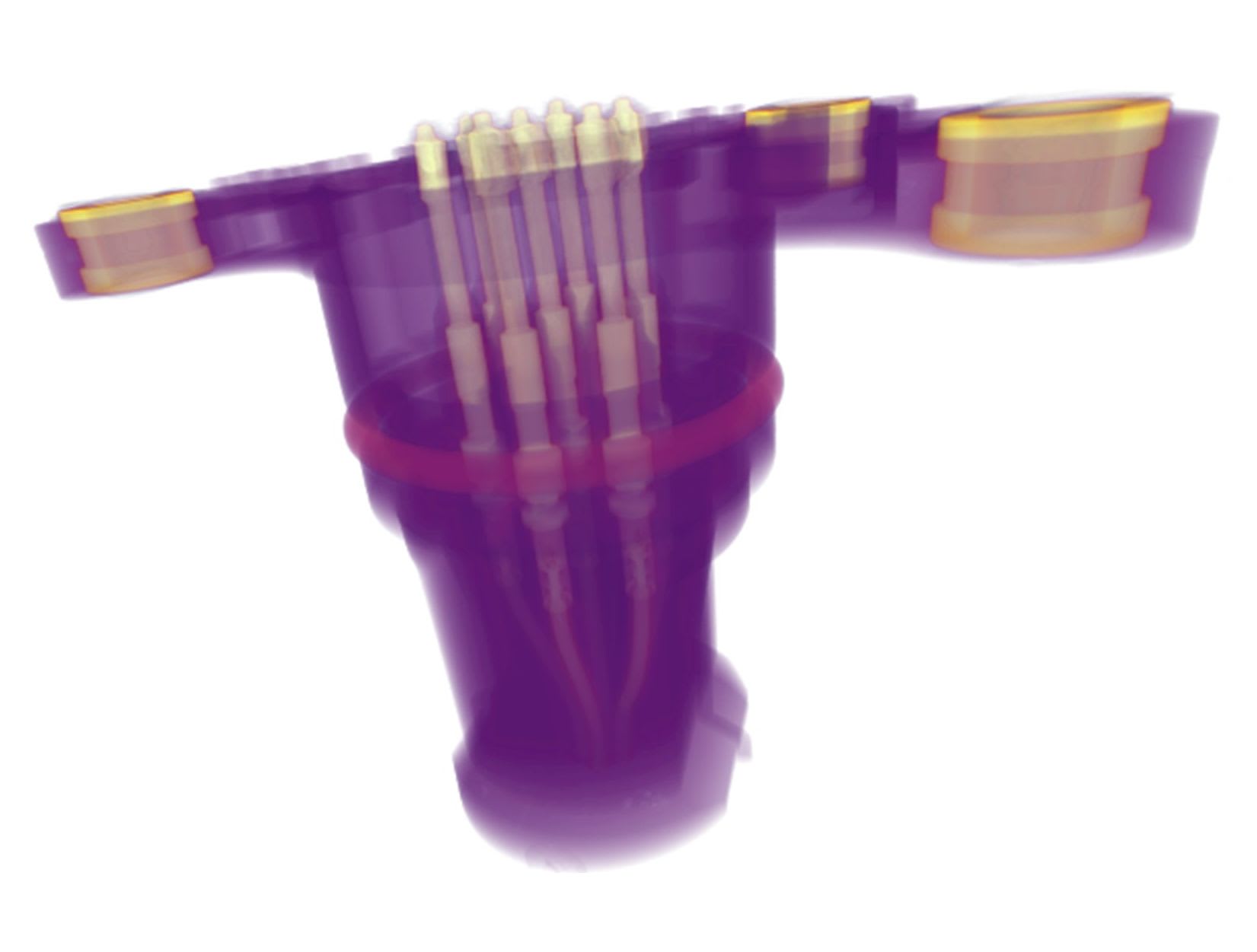
Case study
Defect detection in a 7-pin power connector
With Robert Bosch GmbH Corporate Research, we compared filtered backprojection, dual-energy fusion and QRT on a connector with copper alloy pins in a plastic housing, validated against a polished cross-section. QRT showed voids, gaps and a plastic particle between the pins from a single scan, in half the measurement time of dual-energy CT.
Read the case study
Frequently asked questions about beam hardening
What causes beam hardening in CT?
X-ray tubes emit a spectrum of energies. Material absorbs low-energy photons more than high-energy ones, so the mean energy of the beam rises along its path. A reconstruction that assumes a single energy turns this into cupping and streaks.
What is the difference between beam hardening and metal artifacts?
Beam hardening occurs in every material and grows with thickness and density. It is one of the causes of metal artifacts: behind metal, it combines with photon starvation and scatter, which together cause bright and dark streaks across the slice.
Can I avoid beam hardening with a prefilter?
A copper or tin prefilter reduces beam hardening but does not remove it, and it lowers the signal. Most labs combine a filter with a software correction.
Does beam hardening correction work for multi-material parts?
Linearization assumes a single material, so it fails when metal and plastic share one part. QRT models the X-ray spectrum and the materials, so it also works for multi-material assemblies such as connectors, batteries and electronics.
Do I need to change my scanner or scan settings?
No. QRT reads the raw projections of your existing scanner. You keep your scan settings and your analysis software.
Can I test QRT on my own scans?
Yes. Request a free trial and reconstruct your own datasets on your workstation, or choose the reconstruction service and send us a dataset to reconstruct for you.
Related CT artifacts
Remove beam hardening from your own scans
Reconstruct your own data with QRT in a free trial, or talk to us about your parts.