
Metal artifact reduction in industrial CT
Metal pins, screws and inserts send bright and dark streaks through industrial CT volumes and hide the plastic, adhesive and composite around them. Voxray QRT reconstructs multi-material parts from a single scan, so the material next to the metal stays visible.
What causes metal artifacts?
Metal attenuates X-rays far more than plastics or light alloys. Along the rays that pass through it, three effects add up: beam hardening shifts the spectrum to high energies, so few photons reach the detector (photon starvation) and noise dominates the signal, while photons scattered in the metal add a background.
Filtered backprojection (FDK) assumes a single X-ray energy and exact data. It spreads the errors of these rays across the whole slice, as streaks that start at the metal and connect neighboring metal parts.
How to recognize them
Bright and dark streaks that start at metal parts and run through the slice.
Dark bands between two metal parts, for example between the pins of a connector.
Plastics, adhesives and composites next to metal blur or disappear, so voids, gaps and cracks there go unnoticed.
Metal surfaces look distorted, which makes dimensional measurements near metal unreliable.
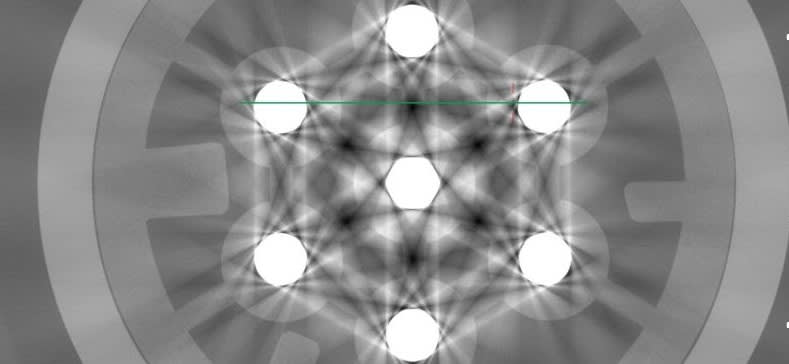
Before and after
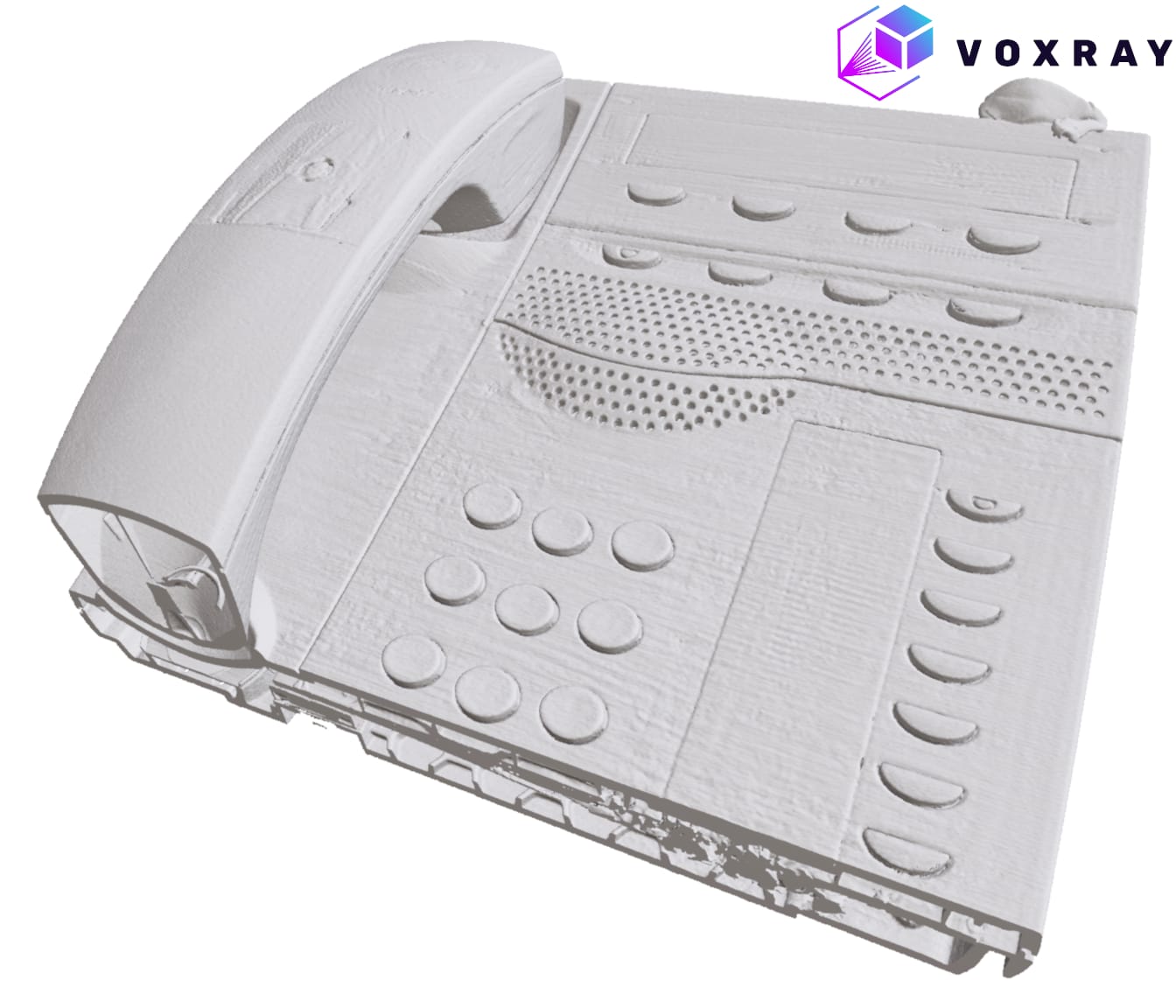
Conventional reconstruction compared with Voxray QRT on real scans. Drag the slider to compare.
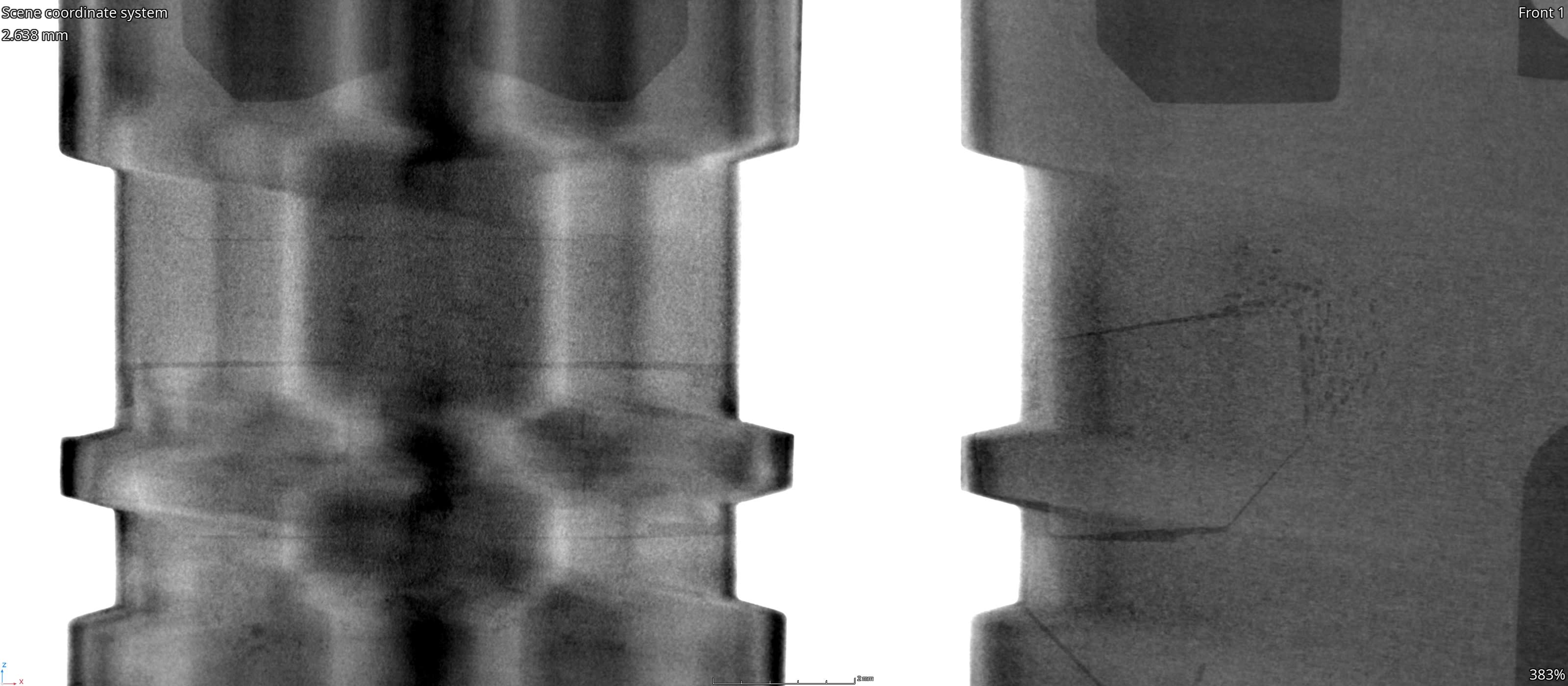
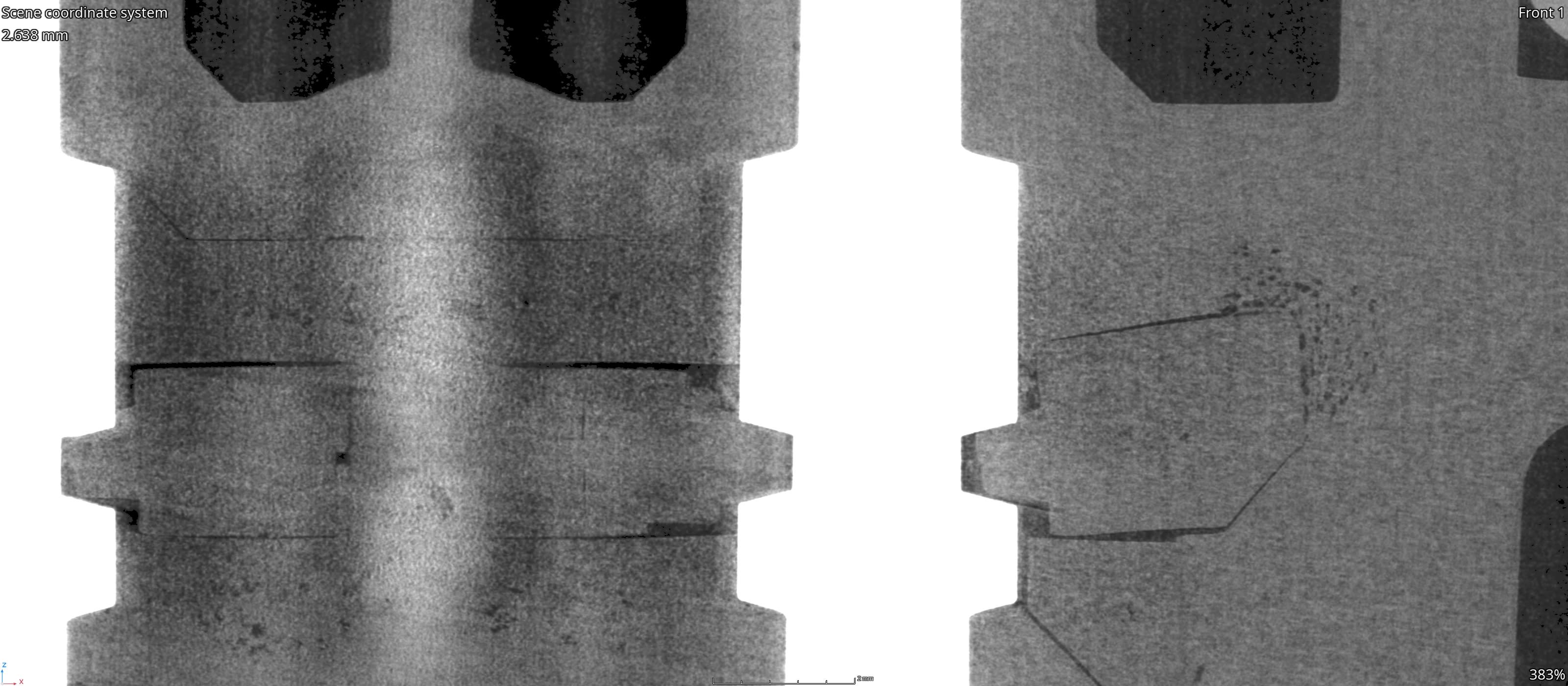
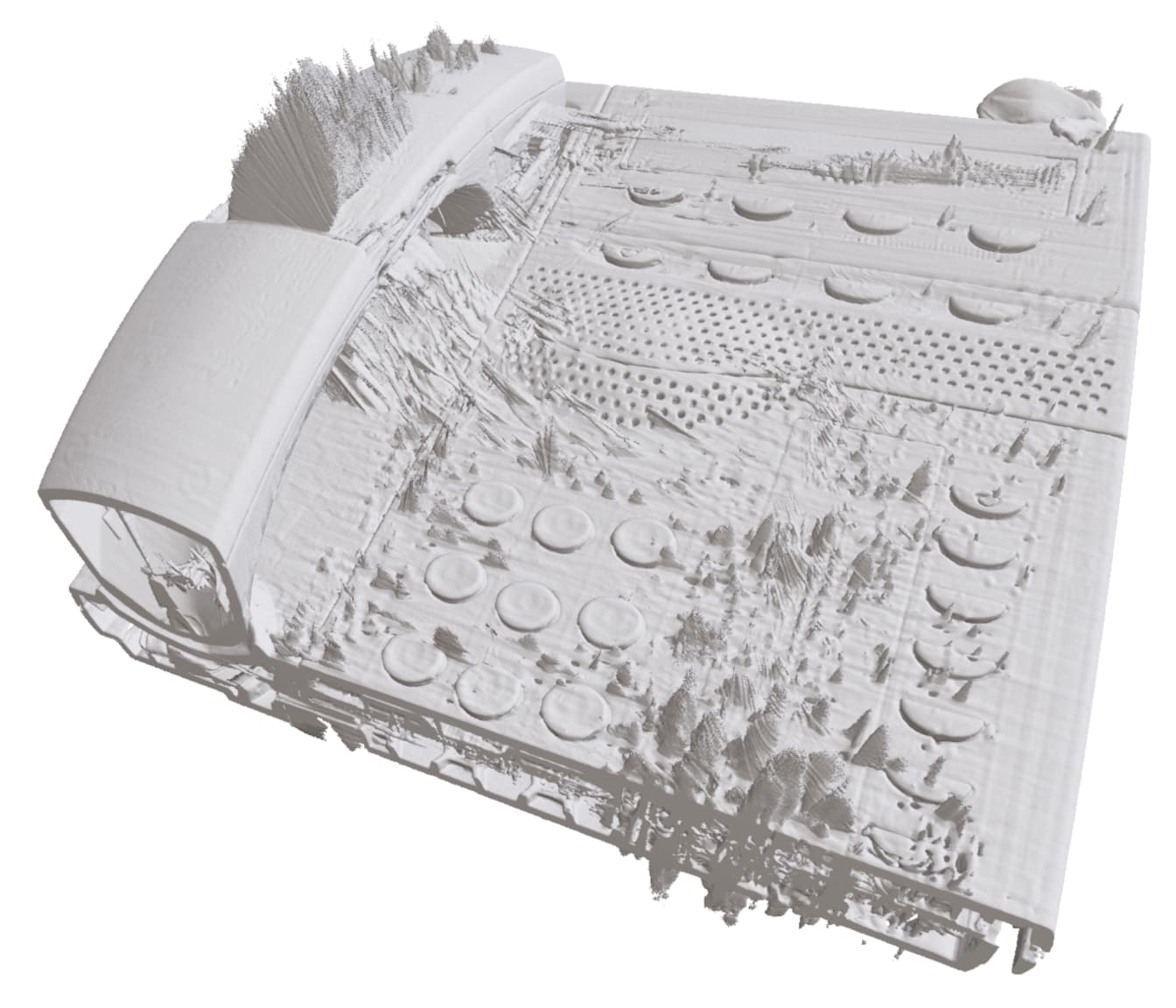
Common ways to reduce metal artifacts
Each conventional method fixes part of the problem and adds a cost elsewhere.
Higher voltage and prefilters
How it works: More high-energy photons pass through the metal and reach the detector.
Limits: Lowers the contrast in the plastic and needs a stronger tube. Streaks get weaker but rarely disappear.
Projection-based MAR
How it works: Segments the metal, removes the rays through it from the projections and fills the gap by interpolation.
Limits: The filled-in data is estimated, so detail right next to the metal is lost, and an inaccurate segmentation adds new streaks.
Dual-energy CT
How it works: Scans the part twice at two tube voltages and fuses the two volumes.
Limits: Doubles the measurement time and needs the two volumes to be registered. In our connector case study, voids between the pins were only partially visible.
Part orientation
How it works: Tilts the part so that fewer rays pass through long metal paths.
Limits: Only helps for some geometries and needs a new scan.
How Voxray QRT reduces metal artifacts
QRT models the polychromatic X-ray spectrum and the physics of the measurement, and computes the volume that best explains the recorded projections. Metal and plastic are reconstructed in the same model, so the streaks of filtered backprojection don't form in the first place and the material next to the metal stays visible.
Multi-material parts
Copper, steel and aluminum next to plastics, adhesives and composites, in one reconstruction.
One scan
No second scan at another tube voltage, which halved the measurement time compared with dual-energy CT in our case study.
Automatic correction
The correction runs during the reconstruction, and the default settings give good results for nearly all datasets.
Your scanner, your software
QRT reads the raw projections of your existing scanner and writes VGI or DICOM for your analysis software.
Case study
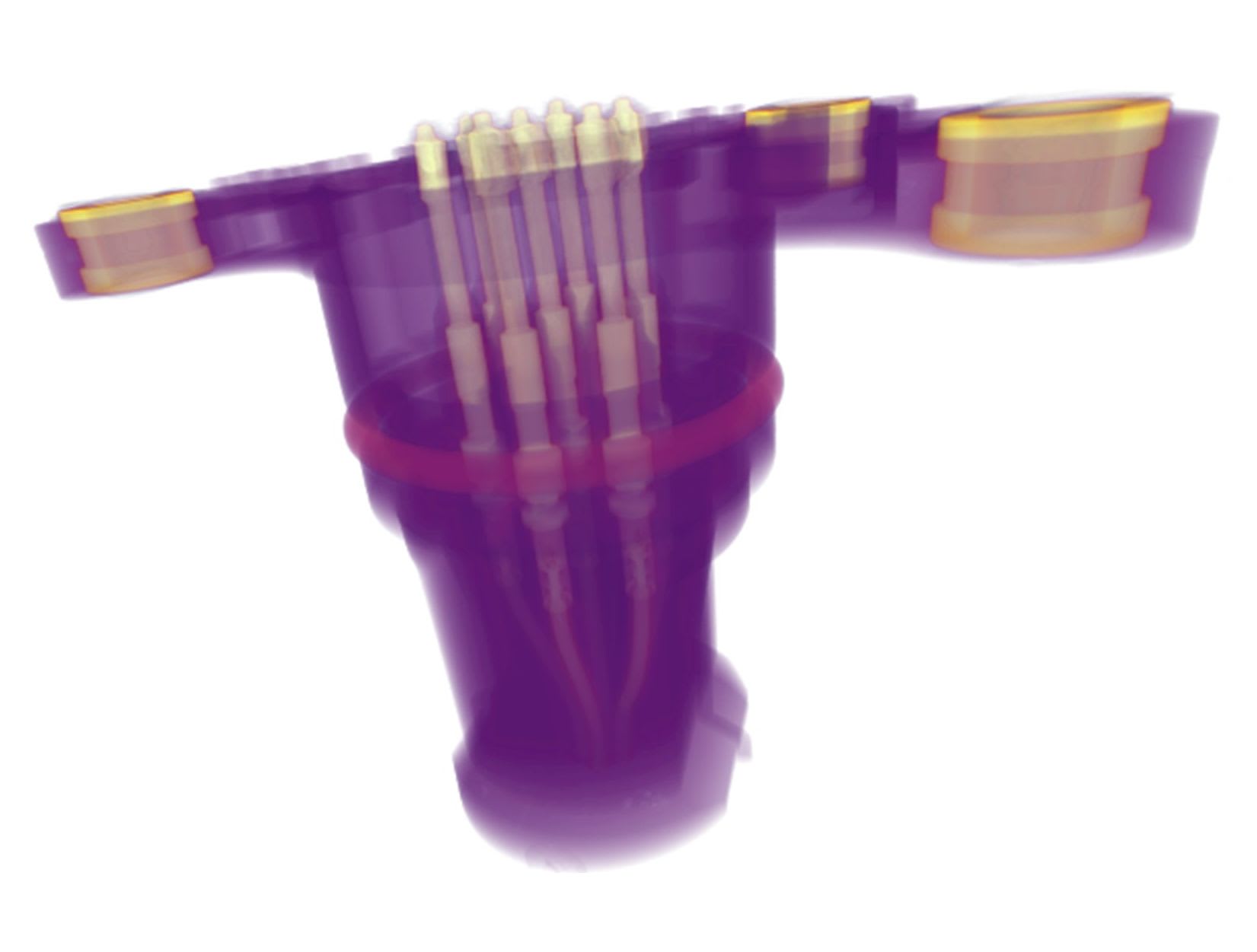
Defect detection in a 7-pin power connector
With Robert Bosch GmbH Corporate Research, we compared filtered backprojection, dual-energy fusion and QRT on a connector with copper alloy pins in a plastic housing, validated against a polished cross-section. Voids between the pins were hidden in filtered backprojection, partially visible with dual energy and clearly resolved with QRT.
Read the case study
Frequently asked questions about metal artifacts
What causes metal artifacts in CT?
Metal absorbs most of the X-rays that pass through it. Beam hardening, photon starvation and scatter make the data along these rays inconsistent, and filtered backprojection spreads these errors across the slice as bright and dark streaks.
What is metal artifact reduction (MAR)?
MAR is the name for methods that reduce streaks from metal. Most replace the projection data that passes through the metal with interpolated values before reconstruction. Model-based reconstructions such as QRT instead model the physics of the measurement.
Does QRT remove all metal artifacts?
No method removes all of them. In our connector case study, QRT resolved voids, gaps and a plastic particle between the pins, but defects directly next to very dense regions remained hard to see with every method.
Do I need dual-energy CT for parts with metal?
Not with QRT. In our connector case study, QRT from a single scan showed more than dual-energy fusion of two scans, in half the measurement time.
Which parts benefit most?
Parts where metal sits next to low-density material: connectors, overmolded parts, battery cells, electronics and composites with metal inserts.
Can I test QRT on my own scans?
Yes. Request a free trial and reconstruct your own datasets on your workstation, or choose the reconstruction service and send us a dataset to reconstruct for you.
Related CT artifacts
Reduce metal artifacts in your own scans
Reconstruct your own data with QRT in a free trial, or talk to us about your parts.